


Rupesh Ghelani
Key Takeaways
- An automatic warning system alerts track workers at least 30 seconds before an approaching train arrives – both acoustically and visually.
- Evolit rebuilt the application that manages the configuration data behind that system from the ground up as a browser-based web application.
- End-to-end versioning, a role model spanning two organisations and single sign-on keep data states clearly governed and fully traceable.
- Interfaces to the operator’s geographic information system and to an RFID client embed the application in the existing system landscape of the rail infrastructure operator.
Wherever work is carried out along a railway line, trains keep running. To make that safe, an automatic warning system alerts the work crews at least 30 seconds before a train arrives, acoustically and visually. This only works reliably if the data behind the system is correct: which warning sectors exist, which IDs they carry, and which data state has been approved.
The application Evolit developed does not trigger the warning itself. Its job sits one level below: it manages and versions the configuration and engineering data the warning system depends on.
Starting Point: A Proven System on a Technical Foundation from 2012
The demands on the warning system’s data are high. Warning sector IDs must be correct and every change traceable: draft states, approved states and historical states have to be kept cleanly apart. And more than one organisation works with the system: alongside the infrastructure operator itself, the planners of a signalling contractor use it too – each with their own roles and permissions.
After more than a decade in service, the goal was therefore not to reinvent the domain logic but to modernise the technical foundation: browser-based, maintainable in the long term and connected to the operator’s central identity and access management.
Implementation: Keep the Domain Logic, Rebuild the Application

The rebuild was based on a jointly agreed, signed requirements specification. Development ran iteratively: feedback came in via the customer’s main contact or directly as tickets in the project system – short paths, quick clarification.
A key task was to transfer the existing domain logic into the new application in full while creating structures that represent versioning, permissions and interfaces consistently.
Two Organisations, One Role Model
The application maps several roles, each with its own permissions. On the operator’s side they range from administration through service and installation to read-only access; the signalling contractor’s planners create the warning system’s computers and approve projects in line with their permissions. The role model therefore had to reflect not only different activities but also different organisations within one shared domain process.
Modern Architecture, Deeply Integrated
Technically, the new solution is a web application running containerised on the customer’s infrastructure. Users log in via single sign-on through the operator’s central identity and access management – and so does the associated RFID client. Security requirements were gathered systematically through Evolit’s ISO 27001 processes; data changes are logged and traceable. Automated tests, static code analysis and reviews with quality gates safeguard quality throughout development.
Outcome: All Warning System Data in One Web Application
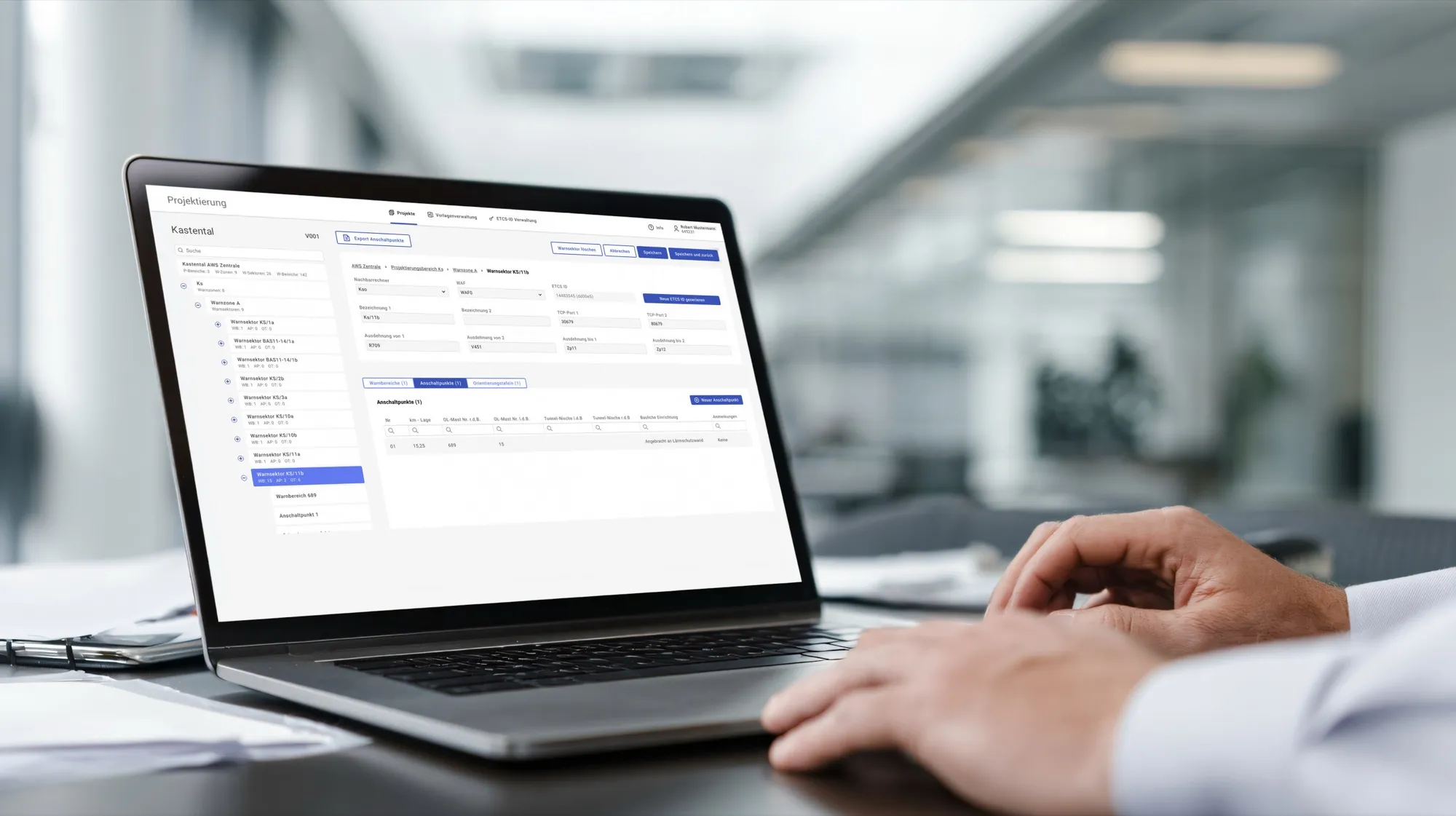
Today, users from both organisations manage the warning system’s data in one central web application – from the individual computer through engineering areas, warning zones and warning sectors to activation points, orientation signs, track sections and switches. The solution is live in production.
Versioned and traceable
Projects are versioned end to end: draft and approved states are clearly separated, historical states are preserved. Which data state was valid at which point in time can be traced in the system at any moment – including a log of every change.
Interfaces instead of a data silo
Approved data is handed over to the operator's geographic information system. The RFID client obtains the warning sector data via an interface and, based on approved projects, programmes the RFID tags at activation points and orientation signs. Excel templates and exports as well as the import of route data round out everyday use.
One building block in a larger solution
Changes to the warning system also require modifications in the interlockings, carried out by signalling contractors. The application supplies the reliable, approved data foundation for that work. Its value therefore lies less in quantifiable savings than in correct, consistent data for a system that protects people.
Outlook: Evolving in Live Operation
The application is continuously maintained and extended: regular releases bring improvements to both the web application and the RFID client. Its modern architecture and clearly defined interfaces are designed to absorb future requirements without another generational rebuild. That keeps a rail domain application grown over more than a decade viable for the long term.
More on "Mobility"
Mobility
ETCS Key Management System for Trafikverket: Secure Key Management for Sweden's Railways
Evolit and Trafikverket are jointly developing an ETCS Key Management System with online key distribution for secure rail operations in Sweden.
Mobility
Train Prediction with Graph Theory: A Research Project Makes Train Runs Computable
Train prediction with graph theory: how ÖBB-Infrastruktur AG and Evolit model train runs and compare forecasting methods on a shared data basis.

Mobility
Digital Train Preparation in Rail Freight: PORTHOS at ÖBB
With PORTHOS, ÖBB-Infrastruktur is digitalising the planning, dispatching and execution of train preparation – from train path ordering to automated train data reporting.