


Julia Rinnhofer
Key Takeaways
- YETI is the yield management system of ÖBB passenger transport: it controls ticket prices, quotas and availability for long-distance services – demand-based and in real time.
- Revenue management is rule- and parameter-driven, fully traceable and deeply integrated into the ÖBB system landscape, from the ticket shop to timetable and reservation data.
- Night services are part of revenue management too: for the Nightjet, YETI controls prices and quotas across all coach types, from seats to motorail.
- Evolit has supported YETI since the initial requirements analysis, combining yield management know-how with railway domain expertise and system integration.
Is a Sparschiene ticket still available? And how much does it cost? The answers are no coincidence. Behind every query in the ÖBB ticket shop is a system that knows the occupancy, quotas and price levels for every single train and responds in real time: YETI, the yield management system of ÖBB passenger transport.
Evolit has helped shape this system from the very first requirements analysis and has been developing it continuously since 2014.
Starting Point: Why Yield Management Is So Complex in Rail
With the liberalisation of the railway sector, competition in Austrian long-distance transport intensified significantly. Operating trains profitably means deploying limited seating capacity deliberately: through price levels, quotas and sales channels, aligned with actual demand. The existing pricing system was too simple and too inflexible for this – a real problem for a strategically important product like Sparschiene.
On top of that, yield management in rail is far more complex than simply offering different prices. Portion working and through coaches, connecting and cooperation trains, cross-border routes with revenue sharing between railways, plus large volumes of timetable, product, reservation and capacity data. And a ticket shop that expects a consistent answer to every query in real time.
Implementation: Railway Domain Knowledge and Yield Management Expertise in One Team
The functional foundations for YETI date back to 2010. Even then, people who are now part of the Evolit team worked on the specification together with the long-distance division of ÖBB passenger transport, the ticket shop team, international partners and yield management experts. In 2013, ÖBB commissioned Evolit to continue the implementation.
Domain First: Expertise in Yield Management and Rail
Yield management in rail combines complex revenue management with the specific demands of railway operations. This intersection is exactly where the Evolit team’s strength lies: deep yield management know-how meets many years of experience with the processes, systems and functional interdependencies of rail transport.
As a result, requirements are not implemented in technical isolation but considered in their full business context. This matters most when things change: new products, timetable adjustments or additional sales logic often affect several parts of the system at once and have to work together consistently, both functionally and technically.
“With YETI we manage prices and capacity in long-distance transport the way today’s market demands. What we value most is the long-standing collaboration: the team knows our business and our system landscape in detail.”
Christoph Hinterleitner
Head of Pricing and Revenue Management, ÖBB-Personenverkehr AG
Traceable Pricing Logic Instead of a Black Box
YETI is based on statistical, rule- and parameter-driven revenue management: pricing follows deterministic calculation logic, keeping it traceable and reproducible. The logic has to account for different trains, products and sales channels as well as timetable changes. Testing is correspondingly demanding – changes to a single rule can affect numerous connections and sales situations.
An Architecture for Real Time and System Integration
Technically, the task was clearly defined: short response times and high availability for a system that revenue flows through, combined with strong data consistency and horizontal scaling. YETI is designed for response times under 500 milliseconds, runs containerised in ÖBB’s cloud infrastructure and is geo-redundant across two data centres. Caching keeps responses fast even under heavy load.
At the same time, YETI is deeply integrated into the ÖBB system landscape: it processes timetable and product data, train capacities and reservations, communicates with the ticket shop and with the decision support system for price optimisation, and provides revenue data to downstream systems.
The business department also has its own administration module: a graphical interface through which a small group of revenue managers maintains quotas, products and master data.
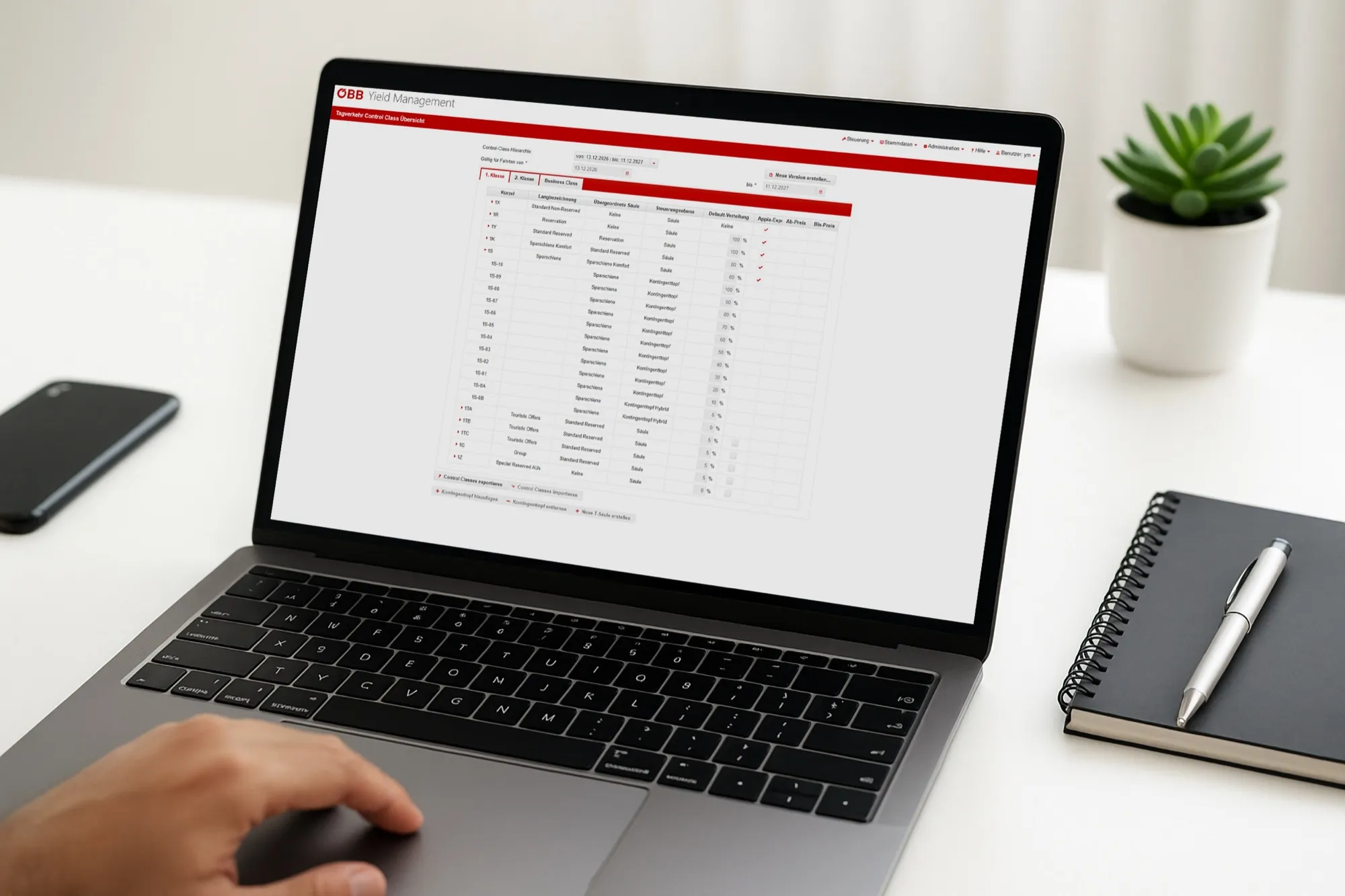
Results: What YETI Enables in ÖBB Long-Distance Rail Today
YETI is live, runs in continuous operation and is the central system for revenue management in ÖBB long-distance transport:
Real-time answers for the ticket shop
For every query from the ticket shop, YETI determines in real time which availability and quotas exist for a train and which price level applies to the product and sales channel.
The pricing backend of Sparschiene
As the pricing backend of the Sparschiene brand, YETI powers one of ÖBB's best-known offers.
Night services are fully integrated
With the Nightjet, the entire night service is part of revenue management: with coach types ranging from seats to couchettes, sleepers, Mini Suites and motorail, and with international connections that bring additional business requirements.
Outlook: From Software Project to Long-Term Product Development
YETI is not a finished project but a system that evolves with long-distance rail: new reservation products, changed product definitions and additional requirements for price differentiation are implemented iteratively in regular releases. What began as a development project has become long-term product development that continuously integrates new business and technical requirements into the existing system.
More on "Mobility"
Mobility
ETCS Key Management System for Trafikverket: Secure Key Management for Sweden's Railways
Evolit and Trafikverket are jointly developing an ETCS Key Management System with online key distribution for secure rail operations in Sweden.
Mobility
Train Prediction with Graph Theory: A Research Project Makes Train Runs Computable
Train prediction with graph theory: how ÖBB-Infrastruktur AG and Evolit model train runs and compare forecasting methods on a shared data basis.
Mobility
Digital Train Preparation in Rail Freight: PORTHOS at ÖBB
With PORTHOS, ÖBB-Infrastruktur is digitalising the planning, dispatching and execution of train preparation – from train path ordering to automated train data reporting.